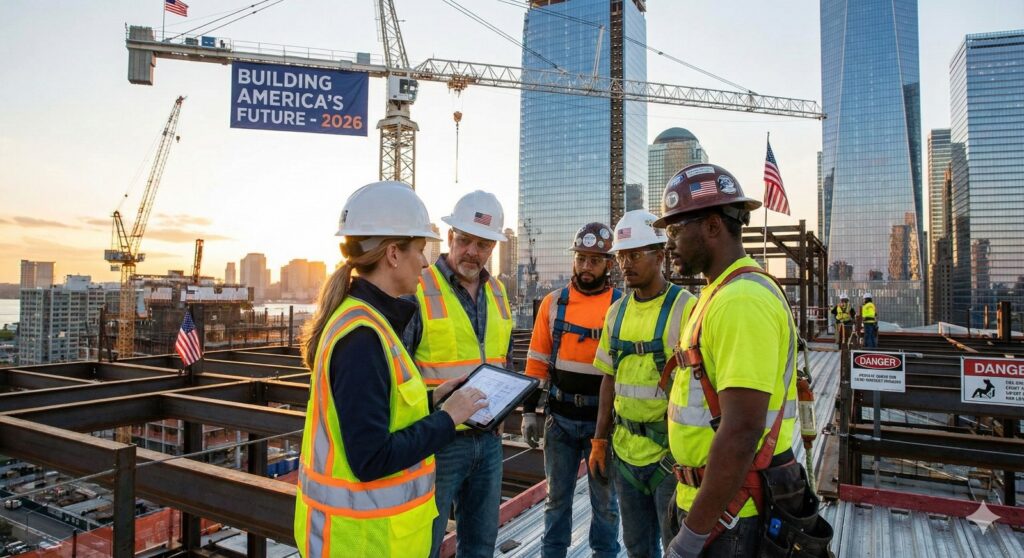
Every single day, you put in a full day’s work. You know what it means to lift, to carry, to build, and to sweat under the sun. It’s hard, honest work. And perhaps, as you finish a long day, you dream of taking that same incredible work ethic to the United States, earning a U.S. wage that can change the future for you and your family. That dream is powerful, and for many, it’s achievable.
The demand for hardworking individuals on American construction sites is real and significant. However, getting there requires more than just a willingness to work; it requires following a specific, legal pathway designed for foreign workers. This isn’t about luck; it’s about strategy and knowledge.
Consider this article your personal, trustworthy roadmap. I am going to walk you through the entire process, from my office here in Lagos, directly to you. We will break down the exact visa you need, show you how to find real construction laborer jobs in USA with visa sponsorship, explain what the work is really like, and, most importantly, teach you how to protect yourself and your hard-earned money from scams. Let’s get to work.
The Reality Check: What You MUST Know First
Before we talk about visas and applications, we must start with an honest conversation to manage your expectations. Building your dream on a foundation of truth is the only way to succeed.
First, understand that the vast majority of these opportunities are for temporary, seasonal jobs. This is not a direct path to a Green Card or permanent immigration. The primary visa used for this work, which we will discuss in detail, is for a temporary period, usually less than a year. The goal is to work for a season, earn good money, and then return to your home country with new skills and savings.
The demand for construction labor in the U.S. is geographically and seasonally dependent. States with booming populations and year-round construction potential like Texas, Florida, and Arizona are always in need. Other states in the north have peak construction seasons during the warmer months (typically April through October). This is the “seasonal” need that makes this visa possible.
Finally, the work is incredibly physically demanding. This is not an office job. You will be expected to be on your feet for 8-10 hours a day, lift heavy materials (often over 25 kg), work in all weather conditions—from scorching heat to biting cold—and perform repetitive tasks. You must be in excellent physical health and prepared for strenuous labor. This is one of the most important physical requirements of the job.
The Golden Ticket: Understanding the H-2B Visa for Construction Work
Now, let’s talk about the single most important key to unlocking this opportunity: the H-2B visa. For general labor jobs USA for foreigners, this is the designated legal pathway. Memorize this name, as it is the foundation of your entire U.S. job search.
What is the H-2B Visa?
The H-2B visa is a non-immigrant visa created by the U.S. government. It allows U.S. employers to hire foreign nationals for temporary, non-agricultural jobs.
The core principle of the H-2B is need. An employer can only hire foreign workers if they can prove to the U.S. Department of Labor that there are not enough willing and able American workers to fill the temporary positions. Given the massive scale of construction projects in the U.S. and the domestic labor shortage, many large construction companies meet this requirement every year. This is the core of H-2B visa construction jobs.
Who Qualifies for the H-2B Visa?
This is the best part: the H-2B visa is not based on your level of education. It does not require a university degree or high-level technical skills. The qualifications are based on the job itself. For a construction laborer role, the primary qualifications are:
- Being from a country eligible for the H-2B program (this list is updated annually, and countries like Nigeria, Mexico, Jamaica, and the Philippines are consistently included).
- Being physically fit and capable of performing the demanding tasks of a construction laborer.
- Having a job offer from a U.S. employer that has been approved for the H-2B program.
- Intending to return to your home country after your temporary work period ends.
The Process in Simple Terms
The H-2B process is driven by the employer, not by you. You cannot apply for this visa on your own; you must have a sponsoring employer. Here is the simplified journey:
- The Employer Proves Their Need:The U.S. employer goes through a complex process with the Department of Labor to get a Temporary Labor Certification. This is the official approval stating they have a legitimate seasonal or peak-load need and have tried to hire U.S. workers first.
- The Employer Files a Petition:Once the certification is approved, the employer files Form I-129, Petition for a Nonimmigrant Worker, with U.S. Citizenship and Immigration Services (USCIS). This petition names the workers they intend to hire.
- You Apply for the Visa:After the petition is approved by USCIS, the final step is yours. You will receive documentation from your employer, and you will then schedule an interview at your local U.S. embassy or consulate to apply for the H-2B visa.
A Day in the Life: What Does a Construction Laborer Actually Do?
When you arrive at a U.S. construction site, you are a vital part of a large team. Your role as a general laborer is to support the skilled tradespeople (carpenters, electricians, plumbers) and keep the project moving forward. Your daily tasks are varied but almost always physical.
Common responsibilities include:
- Site Preparation:Clearing job sites of debris, rocks, and trees. Setting up safety barriers and traffic cones.
- Loading and Unloading:Transporting building materials like lumber, concrete blocks, drywall, and steel from trucks to the worksite.
- Digging and Trenching:Using shovels, pickaxes, and other tools to dig trenches for foundations, pipes, and electrical conduits.
- Operating Basic Tools:Using hand tools like hammers and saws, and sometimes basic power tools like drills or jackhammers under supervision.
- Assisting Skilled Workers:Acting as a “helper” by holding materials in place, mixing concrete or mortar, and fetching tools and supplies.
- Site Cleanup:Keeping the worksite clean and organized to prevent accidents. This is a constant and critical task.
Safety is the absolute number one priority on any American worksite. You will be required to follow strict safety protocols set by the OSHA (Occupational Safety and Health Administration). This includes always wearing your personal protective equipment (PPE), such as a hard hat, steel-toed boots, safety glasses, and high-visibility vests. Following instructions from your supervisor precisely is not just about doing a good job—it’s about keeping yourself and your entire team safe.
The Money Talk: Realistic Salary and Deductions
Let’s talk about why you are making this journey: to earn a good wage. The H-2B program has a crucial protection built in for workers called the prevailing wage.
The prevailing wage is the hourly rate determined by the U.S. Department of Labor for a specific job in a specific geographic area. Your employer is legally required to pay you at least this rate. This ensures that you are paid fairly and that your employment does not negatively affect the wages of U.S. workers.
So, what can you realistically expect to earn? The prevailing wage for a construction laborer varies significantly by state, but you can generally expect a range of $15 to $25 USD per hour. In high-cost-of-living areas or for projects requiring higher skill levels, this could be more. This is significantly higher than what you might earn for similar work in many other countries.
However, your gross pay (the total amount) is not what you take home. You must be prepared for deductions:
- Taxes:You are legally required to pay U.S. federal and state income taxes, which will be automatically deducted from your paycheck.
- Housing & Transportation:Many H-2B employers provide housing and transportation to and from the worksite. They are legally allowed to charge a reasonable fee for this, which will also be deducted from your pay. This should be clearly explained in your work contract.
Finding Legitimate Employers and Avoiding Scams
This is, without a doubt, the most important section of this guide. Your dream can quickly turn into a nightmare if you fall victim to a fraudulent scheme. The key to success is knowing where to look and what to avoid.
Where to Look for Real Jobs
The most common mistake applicants make is randomly emailing U.S. construction companies they find online. This almost never works. The vast majority of construction companies that sponsor visas do not hire individuals directly from abroad. Instead, they work with professional, licensed recruitment agencies located in the workers’ home countries.
Your strategy should be:
- Identify Licensed Recruiters in Your Country:This is your primary focus. Search for “reputable recruitment agencies” or “licensed H-2B recruiters” in your home country. These agencies are the bridge between you and the U.S. employer. They vet candidates, help with paperwork, and facilitate the entire process.
- Use Official Government Resources:The U.S. Department of Labor has a public database called the Foreign Labor Certification Data Center. You can search this database for “H-2B” and “Construction Laborer” to see the names of the actual U.S. companies that have been certified to hire foreign workers. This is a powerful way to verify that a job offer is real.
Red Flags & How to Spot a Scam
Scammers are everywhere, and they make promises that sound too good to be true because they are. Memorize these red flags to protect yourself.
- They Ask You to Pay for the Job Offer:This is the #1 sign of a scam. It is illegal for an employer or recruiter to charge you a fee for the job itself. You will have to pay for your own visa application fee and possibly your travel expenses, but the job offer must be free.
- They Guarantee a Visa:No one can guarantee a visa. The final decision is always made by a U.S. Consular Officer at the embassy. Anyone who promises a 100% guarantee is lying.
- Unprofessional Communication:Legitimate companies and recruiters use official email addresses (e.g., name@company.com), not Gmail or Yahoo accounts. They will not conduct the entire hiring process through WhatsApp or Facebook messages.
- Vague Job Offers with Unrealistically High Pay:If an offer promises $50 an hour for general labor with no experience, it is a scam. Real offers will have a clear job description, a location, and a salary that aligns with the prevailing wage.
- They Pressure You to Act Immediately:Scammers create a false sense of urgency, telling you that you must pay a fee within 24 hours or you’ll lose the spot. Real recruitment processes take time.
Crucial Advice for Nigerian Applicants: The U.S. Mission in Nigeria has repeatedly warned against visa scams. Before you pay any money to a local agent, do your research. Ask for their official license number. Cross-reference the U.S. Company they claim to represent on the official DOL data center. Do not become a victim of avoiding job scams; be proactive in verifying every detail.
Your Step-by-Step Application Guide
Ready to take action? Here is your practical guide, from preparing your documents to stepping into the embassy.
Step 1: Prepare Your CV/Resume
For a laborer position, your resume should be simple, clear, and focused.
- Format:A one-page document is best.
- Content:Include your contact information, a brief summary of your work ethic (e.g., “Hardworking and reliable individual with 5+ years of experience in physically demanding roles”), and a list of your previous work experience. Highlight any experience in construction, farming, or any other physical labor. Emphasize your physical fitness and ability to work in a team.
Step 2: Connect with a Reputable, Licensed Recruiter
As mentioned, this is the most critical step. Research and find a licensed agency in your country that specializes in H-2B placements. Submit your resume and follow their application instructions precisely.
Step 3: The Job Interview
Most interviews will be conducted over a video call.
- Be Professional:Even though it’s a video call, dress presentably and have a quiet, clean background.
- Be Honest:Talk about your experience with physical work. Express your understanding that the job is demanding and seasonal.
- Show You Are Reliable:Emphasize your commitment to safety, teamwork, and showing up on time every day. Employers value reliability above all else.
Step 4: The Visa Application (DS-160 Form)
Once the employer’s petition is approved, you will be instructed to complete the DS-160 online nonimmigrant visa application form. This is a detailed form that asks for your personal history, work experience, and travel plans. Fill it out completely and truthfully. Any mistake or false information can lead to a visa denial.
Step 5: The Embassy Interview
This is the final step. You will attend a visa interview at the U.S. embassy or consulate (for example, the U.S. Consulate in Lagos). The officer’s main goal is to verify your identity and confirm your “non-immigrant intent.”
- Prove Your Ties to Home:You must convince the officer that you will return to your home country after the job ends. Bring evidence of your ties, such as family responsibilities (birth certificates of children, marriage certificate), property ownership, or a letter from a future employer in your home country.
- Be Clear and Confident:Answer the officer’s questions directly and honestly. Know the name of your U.S. employer and where you will be working.
- Do Not Lie:Never provide false documents or information. This will result in a permanent ban from entering the U.S.
Conclusion
Securing a sponsored construction laborer job in the USA is not an easy dream, but it is a realistic one. It is a journey that demands patience, preparation, and a commitment to following the legal process. The path is clear: understand that the work is temporary and physical, focus exclusively on the H-2B visa, partner only with legitimate and licensed recruiters, and prepare diligently for your visa interview.
The hard hat, the steel-toed boots, and the opportunity to earn a life-changing wage are within your reach. The work is tough, but you are tougher.
Start by researching licensed H-2B recruitment agencies in your country today, and take the first official step on your journey to a U.S. worksite.